
Building reputation in a big small town
Austin keeps growing. New people arrive every week, new companies open offices, and new logos show up on the skyline.
And yet, for all the growth, Austin still operates like a big small town.
People want to see, over time, that you as an individual, and the organization you represent, are committed to Austin. Not committed to a single campaign, or a single quarter, or a one time sponsorship, but committed to being part of the community.
There is no magic one thing you can do to build your brand and reputation here. There is no single group that is the core of Austin, or Austin tech. There are countless options for where to put your time and sponsorship dollars, so you need to be judicious.
Think about the last event you went to. Who was the sponsor? And did you move your business to them that week?
Exactly.
A lot of companies invest big dollars into sponsoring something and expect it to be a one time thing, and the community will automatically know them. Or they open their office and host a big party thinking it will get them noticed, and then are shocked when attendance is low and the whole thing is “meh.” Then they do nothing afterward, no follow up, no social media, no staying connected with the people who did show up.
Branding and establishing yourself as an important part of the community for the products and services you offer takes a lot of different approaches, and lots of participation. You cannot be at everything. Your sponsorship budget is not unlimited. Consistency and showing up are part of it, but so is being a resource. Successful people do not just want to come to your party because of free food.
If your first response to any request is, “What’s in it for me?” you will fail. If you lead with, “How can we help the community in the best way?” you will make progress over time.
Sponsorship is not a magic wand
Sponsorship can be a great strategy. It creates awareness, it can open doors, and it signals that your company is putting skin in the game.
But sponsorship is rarely a one and done activity. To make it worthwhile, you need to work with the organizers and help publicize the event before, during, and after.
Many companies put their whole budget into one big sponsorship and hope it turns into instant recognition. They expect the organization to sprinkle them magically with a new reputation. The reality is that a single big check does not build a brand.
A better approach is to choose three organizations where you can sponsor one or more things per year, and where the audiences are linked but not fully overlapping. That gives you multiple touch points across the community without betting everything on one room, one moment, and one event.
Also, be honest about value. Some groups want your money more than they want to create outcomes for sponsors. I have seen companies spend $50,000 on a sponsorship and not see a return. For that same amount, you could sponsor three to five major events with other organizations, build broader visibility, and meet a wider range of people.
And if an organization is overcharging relative to the value they deliver, it is okay to ask for a lower rate. It is also okay to tell them you do not see the value. I have had sponsors tell me what they can spend based on a realistic budget, and we find a way to let them be part of the event. Not at the same level, but in a way that creates a win win.
Organizations need to work with sponsors. If sponsorship pricing is not aligned with value, sponsors do not return. Worse, they burn out and stop sponsoring anything at all.
One reason the Austin Tech Hall of Fame and Gateway Happy Hour have sponsors who return year after year since 2023 is because the events provide value, give exposure, and are priced to be a win win. When sponsors feel appreciated, and they see outcomes, they stay in.
Private dinners are fine, but don’t make them your whole strategy
Some people have come to believe the best use of their marketing is to host private events where you invite prospects to a nice dinner.
That can be good as part of a strategy, but it is limiting.
It starts with how well known you already are. The people you want in the room are being invited to lots of things, and they are judicious with their time because they have jobs, responsibilities, and families.
Also, if you need to control every room, people can feel that you are doing it to get to them. They may take the free meal at the steakhouse, but they are not necessarily seeing you as a giver to the community.
And here is the hidden problem, strangers rarely say yes to a private invitation. So you end up spending big money on dinner for people who already know you.
If you want to build reputation in Austin, you cannot only host. You also have to participate. The best community events need sponsors, and the best organizations point that out to their attendees. People need to know your dollars make the gathering possible and keep the lights on. If the organization is not pointing that out, do not assume people know you made a real investment.
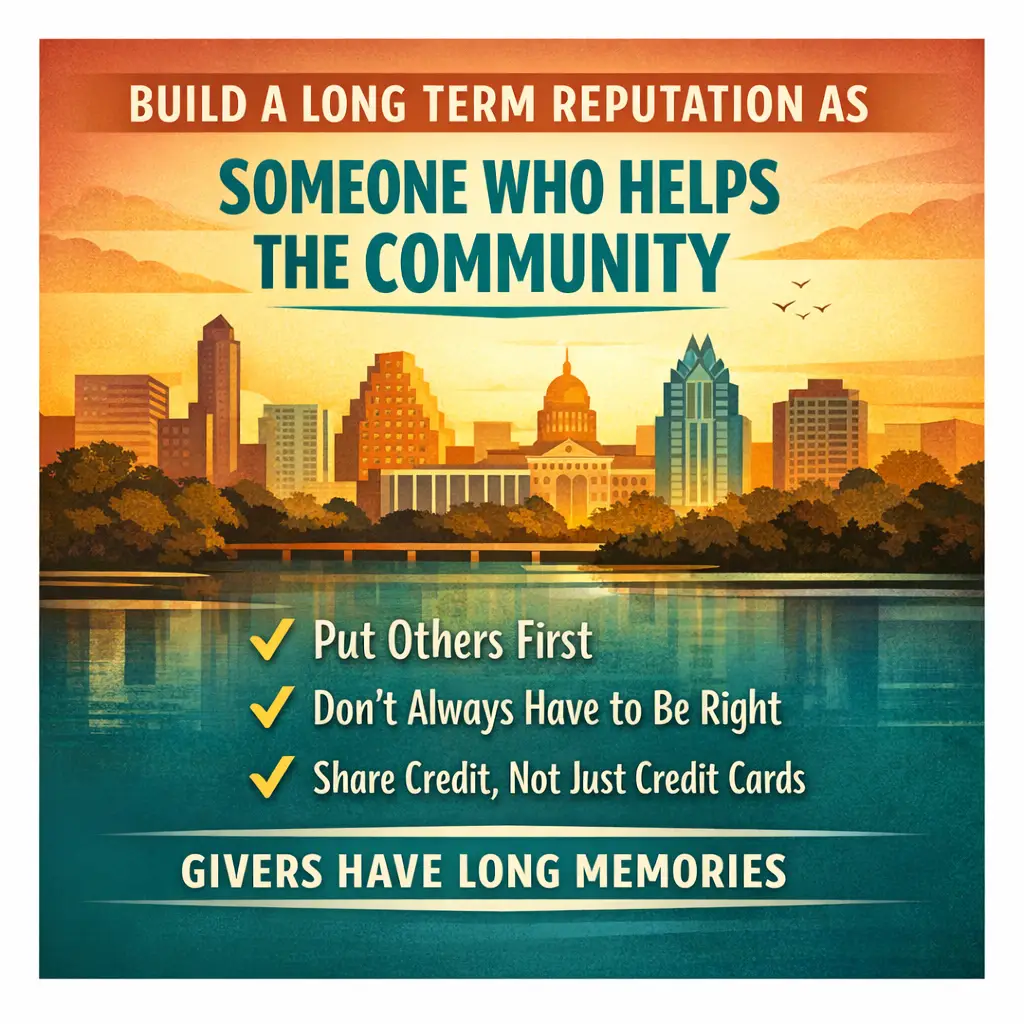
Build a long term reputation as someone who helps the community
This is the part a lot of people miss. You are not just trying to get known. You are trying to be known for the right reasons.
In Austin, the real community builders and community first leaders are always watching. Not in a creepy way, just in the natural way a connected city works. They have long memories, and they tend to do business with people they trust.
That means you do not have to be right all the time. You do not have to be the person who corrects everyone in the room. If you are always jumping in to prove you are smarter, people get tired of it. They do not see you as superior, they see you as exhausting.
It also means you do not have to build your brand by trying to cut out your competition. Short term, you might get a few wins by playing defense, controlling access, or insisting on exclusivity. Long term, the community notices. When everything has to orbit around you, people see your ego before they see your value.
ATC hosted an event that was sponsored by one company and hosted in the offices of one of their competitors. Both were okay with this because they knew the event was a win for the whole community.
The people who thrive over time are the ones who show up and help. They ask good questions. They make introductions. They share credit. They support the mission of the organizations they are involved in. They are not trying to be the center of the story. Position your sponsorship as support for the whole community, not “hey look at my logo” and “listen to me introduce the speaker.”
If you want to be known in Austin, become known as a resource.
Think like a community builder, not a marketer
If you want to be known, you have to be present, and you have to be useful. That means you should get strategic about how your company shows up across the year.
One of the simplest ways to do this is to assign people inside your company to be outward facing in a consistent way.
If you have 12 people who can and should be active in the community, pick six groups and make each person the face for two organizations. Tell them they should be at all the events their two organizations host this year.
Over time, people in town will think you have 40 people on your outward facing team, because they keep seeing your company represented by familiar faces who show up and contribute regularly at the events they attend.
This is also true for individuals. You cannot network at 15 groups and expect traction. Pick two or three, and go to everything they do for one full year.
It can take seven to ten touch points before you even start making real connections in a group. If you only drop in here and there, you never build momentum.
Don’t fear competitors in the room
Some companies refuse to sponsor anything if a competitor is even allowed in the room.
That sounds logical until you remember that your clients and prospects already know who your competitors are. They are not going to run away because two companies support the same organization.
In fact, being in the same community spaces can be healthy. It shows maturity, it shows confidence, and it tells the community you are there to build relationships, not just defend territory.
Volunteer, promote, and be a giver first
If you want to get on an organization’s leadership radar, do things that help them.
Volunteer. Join a committee. Promote their events on LinkedIn. Introduce two people who should know each other. Become the person who helps the community work better.
And when you attend networking events, don’t walk in looking for someone to sell to.
Attend every event with the goal of helping two other people get closer to their goals. If you do that consistently for a year, people will start to see you as someone they need to know.
Show up to get, and you are a taker.
Show up to give, and you become part of the fabric of Austin.
Consistency
With everything, you have to learn what works, then do it consistently. That applies to your whole community strategy, not just one event, one sponsorship, or one relationship.
You build trust by showing up again and again, being useful again and again, and letting people see your company over time in different settings. That same consistency has to show up in your digital and social media presence. Post to give value, highlight others, share what you are learning, and promote the work happening in the community, even when you are busy. If you only show up online when you have something to sell, or only show up in person when you have something to gain, people can feel it.
The hard truth is that establishing a strong reputation in Austin often takes a few years. There are no shortcuts. The people who promise shortcuts are usually selling you a dream, and their real business model is taking your money. Buyer beware.
One final challenge
Pick your lane. Make a plan for the next 12 months. Don’t put your whole sponsorship budget in one bucket. Invest in a few communities that align with your goals, then show up like you mean it.
Austin will reward the companies who commit, contribute, and build trust the long way.
That is how you get known here.