
By Kim Brushaber (originally posted on Kim’s LinkedIn blog)
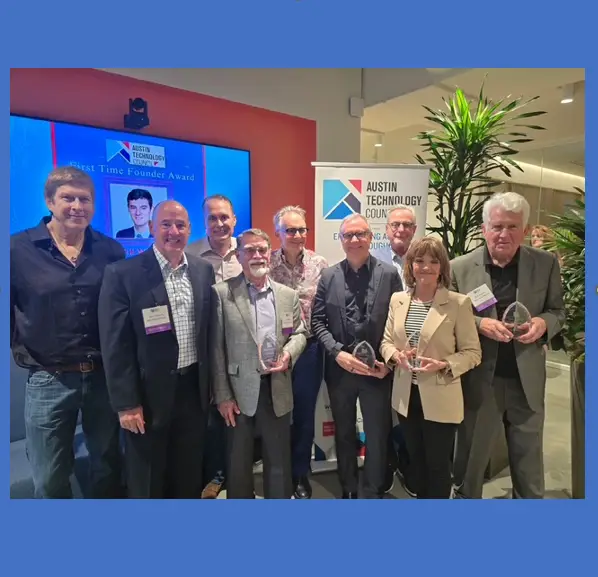
Eight Austin legacy legends, one new honoree, and the night Austin reminded me what “accomplished” actually looks like.
When the Brain Goes Quiet
There are events you attend to network. There are events you attend because you should be there. And then there are events that quietly take you apart while you’re standing near the door with a drink in your hand, trying to look like a person who has their thoughts organized.
Last night was the Austin Technology Council Hall of Fame induction ceremony, and I walked in expecting to leave with a notebook full of insights and something coherent to say about it. Instead I left stunned into a kind of productive silence I haven’t felt in years. My brain stopped capturing data. It just sat there, completely full, watching something rare unfold in real time.
I have been to a lot of events. I mean “A LOT” of events. I’ve sat in boardrooms with people who carry their accomplishments out in front of them like a shield. What happened last night was the opposite of that, and I want to try to tell you about it, even though I’m not sure I have the right language for it yet.
The evening honored eight legacy inductees and unveiled the 2026 Austin Tech Hall of Fame honoree in a reveal kept secret until the night itself. The First Time Founder Award was also recognized, going to Will Wilder of Wilder Systems, who had another commitment and couldn’t be there in person. That’s ten people whose combined fingerprints on this city represent decades of building, funding, founding, mentoring, and showing up before anyone asked them to. And not one of them came in wearing it.
I know this because I helped greet people at the door.
Setting the Tone at Check-In
Thom Singer asked me to help welcome attendees as they arrived. It was a high-security event with multiple checkpoints just to reach your nametag, and over 200 people came through without complaint, without eye-rolls, without a single person pulling rank. Warm. Patient. Present.
Robert Metcalfe, the man who invented Ethernet, stood in line and gave his name quietly, just like everyone else. No performance of importance. No impatience with the process. Some of my fellow greeters were younger and didn’t immediately recognize who was walking in. I did, and I felt the weight of it every single time. That’s him. That’s the ACM Turing Award winner. Standing in line. Being a person. I did a little bit of a fangirl thing. I am a long time Austin techie afterall.
It set the tone for everything that followed.
I’ve been in rooms with people who have that rare, indefinable charisma. The kind where someone takes a stage and you’d sign up for whatever they’re selling before they finish their first sentence. Where you leave feeling genuinely moved, motivated, lit up in a way you can’t fully explain. Last night, every single person who stepped to that podium had it. All nine of them. The kind of presence that makes it completely obvious why each of them has had the impact they’ve had on this city and on everyone whose path crossed theirs. It wasn’t performance. It was conviction, worn lightly, carried in the body like it had always been there.
Which is why my note-taking instincts at events simply stopped working. I was in Broadway-audience mode, the kind where you don’t reach for your phone because you’re afraid to miss even a second of what’s happening in front of you. I just wanted to sit there and be present.
You’ll forgive me, then, if what follows is more feeling than transcript.
Nine People Who Built Something That Outlasted the Moment
I want to be honest with you: each of these people deserves their own book. Several of them have already written a couple. What I can offer you is a small sense of who they are and what they left in the room last night, because the bios only tell part of the story and the part that stays with you isn’t in the bios anyway.
Ken DeAngelis co-founded Austin Ventures, which deployed more than $4 billion across ten funds, investing roughly half of that directly into Austin companies. Over 230 of them. Tens of thousands of jobs. The fingerprints of Austin Ventures are on the early chapters of companies people now treat as obvious facts of Austin’s landscape. What Ken shared last night was quieter than the numbers. He talked about recruiting executives from elsewhere, people nervous about uprooting their families for an unknown city and an uncertain bet. He told them that if the company they were coming to lead didn’t work out, there were plenty of other great companies, plenty of other good places for them to land. That wasn’t a sales pitch. That was someone who genuinely meant it, and the executives he recruited knew the difference.
Hugh Forrest spent more than three decades building South by Southwest into one of the most influential gatherings of technology, culture, and innovation on earth. He also co-organized the Austin Reggae Festival for over thirty years, quietly raising more than a million dollars for the Central Texas Food Bank. What you won’t find in his bio is that he was invited to be inducted last year and declined. SXSW was in transition, something was shifting in his own life, and he didn’t want that backdrop attached to this recognition. He asked Thom to wait. He stepped down from SXSW the month before last year’s ceremony. Last night, with a year of clarity between him and that chapter, he was ready. What Hugh did in that speech was hold all three things at once: he protected what mattered most by waiting until the moment was right, he was open enough to show his vulnerability to a room full of peers, and he honored his wife publicly for the partnership that carried him through the hardest seasons. I happened to be sitting next to her during his speech. She was lit up from the inside, the kind of pride and excitement that can’t be manufactured or performed, pure joy at watching someone she loves be seen the way she has always seen him. Watching her face was its own separate gift.
Brett A. Hurt launched Coremetrics and sold it to IBM for $300 million. Then built Bazaarvoice to a unicorn IPO. Then co-founded data.world, which raised over $150 million and was acquired by ServiceNow. Brett went to UT a couple of years before I did. Same MIS degree. Same starting point. I’ve watched his trajectory from a parallel lane for decades, always a few circles removed, always aware that he was moving faster and building bigger. But what he brought to the stage last night wasn’t the resume. It was something closer to a mission. He talked about love. About wanting to spread it. About writing a book about it and hosting a podcast about it and genuinely believing that the work of making the world better is not separate from the work of building companies. Someone who has accomplished that much could show up to collect. Brett showed up wanting to give something away.
Joe McCall is a seventh-generation Texan, a former offshore rig insurance surveyor, and someone who made his way to Austin in 1980 with good timing and a lot of instinct. What he helped build here is woven into the DNA of how this city networks and grows. He was part of the Chamber of Commerce’s early push to recruit California companies to Austin, a campaign that kicked off a wave of relocations that is honestly still going. But the story that stayed with me is the one about what became the Austin Technology Council. It started as the Austin Software Council, Joe at the center of it, pulling leaders into a room simply to share their stories and help each other grow. Eight people at first. Then more. Eventually over fifty. Word got out. Someone from Silicon Valley called Joe and said they wanted to come speak at one of his events. Joe was genuinely perplexed. The person explained: you can’t get that many people in the same room in Silicon Valley to share ideas openly like this. Not then. What Joe understood, maybe before anyone had language for it, was that the willingness to share, to be generous with knowledge in a room full of people who could theoretically be competitors, was itself the competitive advantage. He ran the early programs team, shaped how the conversations were structured, and helped build the connective tissue that made Austin’s networking culture feel different from anywhere else. He’s 75 years old and made a comment last night about not really being ready to be done yet. I’ve been sitting with that sentence all morning.
Bob Metcalfe invented Ethernet, founded 3Com, has a National Medal of Technology, an IEEE Medal of Honor, and the 2022 ACM Turing Award. He has lived more distinct professional lives than most people have career years, and he approaches each new one with the same forward-leaning curiosity. Currently he’s a computational engineering research affiliate at MIT, working on modeling geothermal wells, because of course he is. Last night he did something none of the other speakers did: partway through his remarks, he simply opened the floor to questions, like a professor who finds a good conversation more interesting than a prepared speech. A man with that many chapters behind him, and what he wants most is to hear what you’re wondering about.
Jan Ryan spent her early career as VP of Sales at Vignette and looked around the room one day and counted the women in it. The number was too small and she decided to do something about that. She founded Women@Austin in 2012, one of the first organizations specifically dedicated to connecting and advancing women across Austin’s tech and startup community. She later co-created the Kendra Scott Women’s Entrepreneurial Leadership Institute at UT, where she still teaches and mentors. What I want to tell you about Jan Ryan that isn’t in any official bio is what happened after the awards were presented. Women of every age and generation formed a loose, warm orbit around her. Not networking. Not transacting. Just wanting to be near her. That kind of magnetism doesn’t get manufactured. It gets earned over twenty years of genuinely showing up for people.
Joel Trammell co-founded NetQoS with his wife Cathy, a research scientist with a doctorate in telecommunications, and was refreshingly clear last night about who actually had the intellectual foundation the company was built on. He credited Cathy as the brains of the operation without a moment’s hesitation, the kind of acknowledgment that lands differently when it comes from someone who has spent 30 years in the CEO seat. They secured funding months before the dot-com bubble burst and delivered 31 consecutive quarters of double-digit revenue growth before selling to CA Technologies for more than a 10x investor return. He co-founded CacheIQ next, acquired by NetApp in 18 months for a 7x return. He’s spent the last 15 years teaching other CEOs how to actually operate, which might be the highest-leverage thing he’s done. I moved seats during the event to give Thom a better position as emcee and ended up next to Joel without realizing it at first. Just a person, being a person.
Peter Zandan, PhD has been in Austin since 1977 and has spent nearly five decades building companies, backing people, and giving back to the city that shaped him. He took IntelliQuest public on NASDAQ. Founded Zilliant. Created the Zandan Poll to give Austin a way to understand its own civic life year over year. He has advised Steve Jobs, Bill Gates, Martha Stewart, Goldman Sachs, and McKinsey. He’s currently Executive Chairman of Quantified.ai, on the board of Meow Wolf, and serving as Special Advisor to the National Academies of Sciences, Engineering, and Medicine. He told a story last night about being at his kid’s soccer game, talking through an early business challenge with someone in the stands, when another parent who overheard the conversation walked over. That parent was Ken DeAngelis. Ken handed him a term sheet not long after. Nearly fifty years in Austin, and the through-line in everything Peter has done is that he has never stopped caring about the city more than the credit.
Tyson Tuttle led Silicon Labs for nearly a decade, growing it into an $8 billion company, before launching Circuit, an AI platform organizing unstructured manufacturing and supply chain data, which has already secured $30 million in angel funding. He was the 2026 honoree, kept secret until the night itself. He was sitting directly behind me when the emcee began reading the accolades, and when I turned around, he gave me this small, quiet, coy smirk. He already knew. He was just letting me in on it. Tyson also announced that a portion of his Circuit equity is being allocated to educational initiatives. I hadn’t heard of many companies doing that before, and I genuinely hope it becomes a trend worth naming.
The Part Where They Gave the Credit Away
Here is what I keep returning to this morning. Every single person on that stage had enough accomplishment to justify an enormous ego. Not one of them brought one. That alone would be worth writing about. But there was something else, and I think it’s actually the more important thing.
Over and over, speaker after speaker took part of their time at the podium not to list what they’d built, but to point at someone else in the room and say: this person mattered to my story. This person helped shape what I became. I watched people with the standing to absorb all the credit in the room insist on distributing it instead. The warm references between honorees. The laughter of recognition when someone named a name that half the room already knew and loved. The way Ken showed up in Peter’s story and Peter’s story illuminated something about what Ken actually does when no one’s watching.
This resonated somewhere deep for me, because I’ve always believed in giving teams their flowers. The best moments I’ve had leading product weren’t the ones where I got the credit, they were the ones where I got to watch a team take a victory lap after a hard release and know that the celebration belonged to them. That instinct was sitting in that room last night, reflected back at me, scaled up to an entire ecosystem. It’s not about one person being elevated. It’s about all of them lifting everyone around them, and understanding that Austin got built the way it did because the people doing the building kept doing that.
What I Left Carrying
Here is what I want to be honest about.
I felt accomplished walking into last night. I have built things I’m proud of. Led teams. Shaped products. Written pages. Started something. I have decades of hard-won scars and a few receipts to show for it. I don’t walk into most rooms feeling small.
Last night recalibrated me in ways I’m still processing this morning, and I mean that in the best possible way. It was like standing at the Trevi Fountain in Italy and realizing you’ve stopped throwing coins wishing to come back and started just standing completely still, trying to press the moment into memory because you understand you are inside something larger than yourself and you don’t want to lose a single second of it to distraction.
That room needed a designated survivor. Not because it was dangerous, but because the collective brain trust, the decades of vision and risk and generosity gathered in one place, represented so much of what Austin has become. If something had happened to that gathering, the city would have felt it.
What I walked out carrying wasn’t intimidation. It wasn’t inadequacy. It was something I don’t have a clean word for yet. A recalibration of what’s still possible. A hunger I didn’t know I needed to feel again. A sense that the version of “accomplished” I’ve been carrying around in my head has a much higher ceiling than I’ve been treating it, and that the distance between where I am and where I could reach isn’t a reason to feel behind. It’s an invitation. These people didn’t build Austin by sitting with what they’d already done. They built it by staying curious, staying generous, and staying in the game long after they could have reasonably stopped.
Maybe I’ll do something great with that feeling. Maybe the demands of ordinary life will eventually pull me back toward the familiar rhythms, because that is an honest thing to say. But right now, today, this morning, I want to live inside this feeling as long as I possibly can. I want to let it reshape what I reach for. I want to be someone who shows up to Austin before they need something from it, and keeps showing up after they get it.
Thom Singer has believed for years that you cannot build on a foundation you don’t know exists. Last night, over 200 people showed up to know the foundation. And I was lucky enough to be one of them.
On the drive home, I called my husband and found myself singing it under my breath, the line that had been echoing since I walked out the door: I was in the room where it happened. And if I’m being precise about it, I was in a room with the people who were. The ones who built Austin into the Austin we all get to live and work in now, who shaped it with their funding and their founding and their showing up, who did the things that became the foundation before most of us arrived to stand on it. In the musical Hamilton, that song is about wanting desperately to matter, to be present for the moments that change everything. Last night I didn’t have to want it. I just got to be there.
************************
ATC reposted this article with the author’s permission, as it was felt she captured the depth of the special evening. If you enjoyed the 2026 Austin Tech Hall of Fame event, we encourage you to nominate people for next year and plan to attend. If you did not attend, do not miss the 2027 event.
More information is available about the Austin Tech Hall of Fame on the special hall of fame website.