
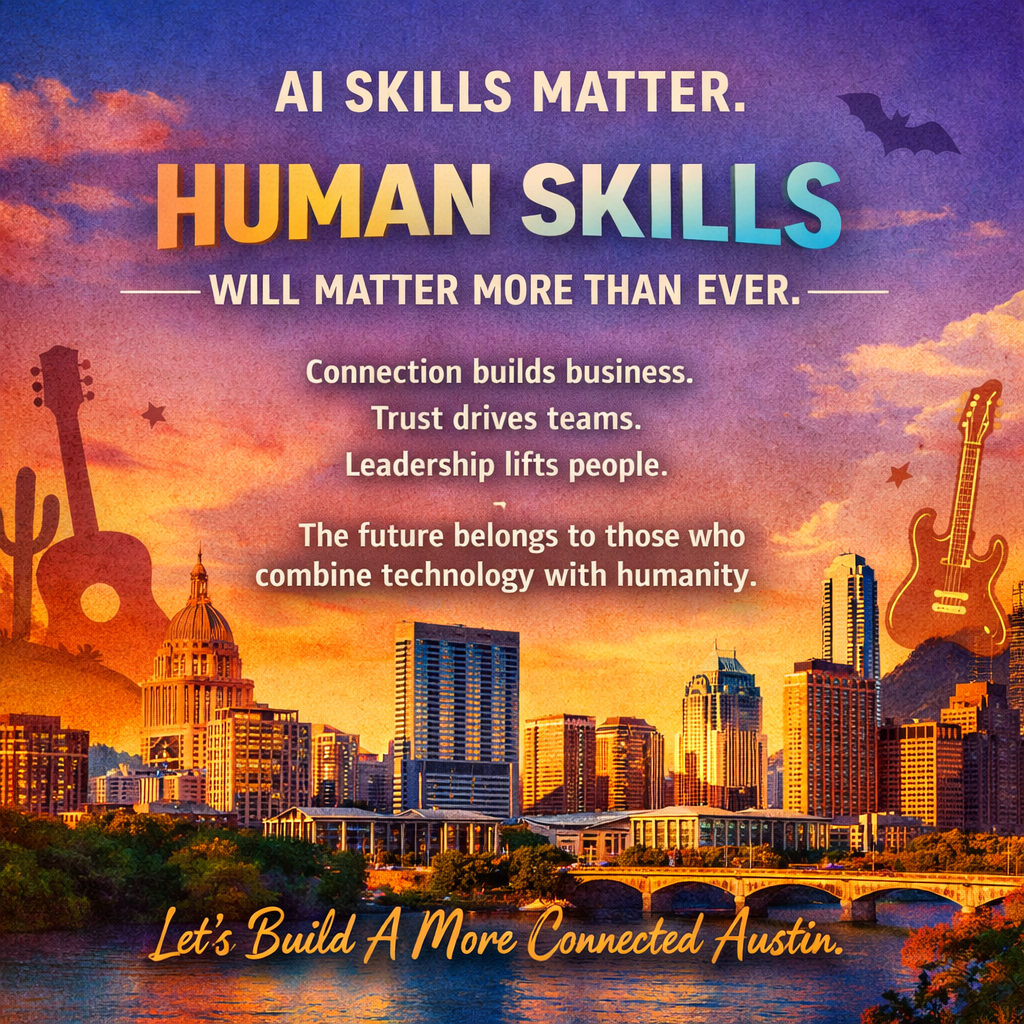
Everyone is rushing to train people how to use AI.
That makes sense. Companies need their teams to understand the tools, experiment with new systems, and build comfort with what is changing. Across every industry, AI literacy is becoming part of modern business literacy.
But the smartest organizations will do something else at the same time. They will invest in the human side of business with equal seriousness.
That means better communication:
- Better listening.
- Better leadership.
- Better collaboration.
- Better trust building.
These are not “soft” extras. They are core business capabilities.
As AI becomes more common, the ability to connect with other people will become more valuable, not less. Technology can accelerate work. It can organize information. It can support decision making. But it does not replace the need for judgment, empathy, courage, relationship building, and the kind of conversations that move teams and communities forward.
The future will not belong only to the people who know how to prompt a machine.
It will belong to the people, and the companies, that know how to combine technology with humanity.
That is where Austin has a real opportunity.
Austin has long been known for innovation, entrepreneurship, and growth. We are a city full of builders, engineers, founders, investors, creatives, and problem solvers. But if we want to remain a top technology hub, we cannot focus only on technical advancement. We also have to strengthen the community side of innovation.
That means asking bigger questions:
- Are we creating places where people from different sectors actually meet?
- Are we helping new arrivals find their way into the broader business community?
- Are we encouraging rising leaders to build relationships outside their own companies?
- Are we teaching managers how to lead people through change, not just deploy new tools?
- Are we investing in trust across the ecosystem?
These questions matter because the Austin of today is not the Austin of twenty years ago. The community is larger, faster, and more spread out. There are more companies, more people, and more opportunity. But there are also more gaps between people. Too many professionals live in silos. Too many companies stay inside their own walls. Too many talented people never quite find their place in the wider ecosystem.
If we want Austin to thrive in the AI era, we need to build more than smarter companies.
We need to build a more connected tech community.
So what could that look like?
- It could mean more gatherings that are open and accessible, not just curated for the usual insiders.
- It could mean creating more chances for senior leaders to meet emerging talent.
- It could mean peer groups for managers who need help leading through uncertainty.
- It could mean company leaders encouraging employees to engage in the broader community, not just stay focused on internal goals.
- It could mean more cross functional conversations between startups, enterprise companies, universities, investors, and civic groups.
- It could mean treating relationship building as part of workforce development.
- It could mean making collaboration a bigger part of how we define innovation.
This is where organizations like the Austin Technology Council can help. Not by claiming to be the center of everything, but by helping create more threads that run through the community. The more connected our ecosystem becomes, the stronger it gets.
AI will keep evolving. That is certain.
But so much of what makes a business community strong has not changed. People still need trust. Teams still need leaders who can communicate clearly. Companies still need cultures where people feel seen, supported, and challenged. Communities still need places where ideas can collide and relationships can form.
Austin’s future will not be shaped by technology alone.
It will be shaped by how well we stay connected while technology changes around us.
That is not secondary to innovation.
It is part of what makes innovation work.
******************
The Austin Technology Council was founded in 1992 to help unite the tech community in Central Texas and to promote the growth of our technology ecosystem. Over the years ATC has tried many paths, but today the organization is focused on community, collaboration, and conversations. As a grassroots organization this is not about any person, it is about the greater region’s tech reputation. As the business world faces many changes, the answer is within community groups that look forward to find ways to work with other groups that are also working to promote the same outcomes. The success of tomorrow will be created by how our community engages today. ATC is asking for the support of the real future leaders in tech.